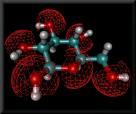
| Abstract: | The title reaction was undertaken to establish the interaction between amantadine and molybdate at physiological pH. Identical FTIR spectra, TG-DTA curves and CHN data of the complexes formed from three solutions at pH 1.5, 7.4 and 8.0 indicate that the same complex was formed at all the three pHs. The FTIR spectrum shows shift in peaks corresponding to primary amino group of the drug due to coordination to molybdate. An octahedral geometry is assigned to the complex. The kinetics of the complexation has been studied at low concentrations of the reactants using UV-visible spectrophotometry. At pH 7.4, the initial rate varies linearly with [molybdate]. A plot of initial rate versus [drug] is linear passing through origin. These results indicate that the drug and molybdate react at pH 7.4 even at low concentrations. At pH 1.5, the rate increases linearly with increase in [drug] but decreases with [molybdate]. The effect of pH and ionic strength on the rate of the reaction has also been studied. A suitable mechanism has been proposed for the reaction. Reaction between the drug and molybdate even at low concentrations and the fact that the amino group of amantadine required to be free for its function as antiviral, is bound to molybdate in the complex suggests that simultaneous administration of the drug and molybdate supplements should be avoided. |
| URI: | http://dyuthi.cusat.ac.in/purl/2979 |
| Files | Size |
|---|---|
| Dyuthi-P00414.pdf | (143.3Kb) |
| Abstract: | Vanadia/ceria catalysts (2–10 wt% of V2O5) were prepared by wet impregnation of ammonium metavanadate in oxalic acid solution. Structural characterization was done with energy dispersive X-ray analysis (EDX), powder X-ray diffraction (XRD), BET surface area measurements, FT-IR spectroscopy and nuclear magnetic spectral analysis (51V MASNMR). XRD and 51V MASNMR results show highly dispersed vanadia species at lower loadings and the formation of CeVO4 phase at higher V2O5 loading. The catalytic activity of catalysts was conducted in liquid phase oxidation of ethylbenzene with H2O2 as oxidant. The oxidation activity is increased with loading up to 8 wt% V2O5 and then decreased with further increase in V2O5 content to 10 wt%. Different vanadia species evidenced by various techniques were found to be selective towards ethylbenzene oxidation. The CeVO4 formation associated with increased concentration of vanadia on ceria results the production of acetophenone along with 2-hydroxyacetophenone. |
| URI: | http://dyuthi.cusat.ac.in/purl/2322 |
| Files | Size |
|---|---|
| Dyuthi-P00001.pdf | (525.3Kb) |
| Abstract: | Cyclohexanol decomposition activity of supported vanadia catalysts is ascribed to the high surface area, total acidity and interaction between supported vanadia and the amorphous support. Among the supported catalysts, the effect of vanadia over various wt% V2O5 (2–10) loading indicates that the catalyst comprising of 6 wt% V2O5 exhibits higher acidity and decomposition activity. Structural characterization of the catalysts has been done by techniques like energy dispersive X-ray analysis, X-ray diffraction and BET surface area. Acidity of the catalysts has been measured by temperature programmed desorption using ammonia as a probe molecule and the results have been correlated with the activity of catalysts. |
| URI: | http://dyuthi.cusat.ac.in/purl/2321 |
| Files | Size |
|---|---|
| Dyuthi-P00002.pdf | (380.1Kb) |
| Abstract: | Titania, sulfated titania and chromium loaded sulfated titania were prepared by sol–gel method and characterized using different technique. Phenol is nitrated regioselectively by nitric acid using chromium loaded sulfated titania catalysts. A remarkable ortho selectivity is observed in solid state nitration to yield exclusively ortho-nitrophenol. Compared to the conventional process, phenol nitration over solid acid catalyst is a clean and environment friendly process. Catalytic activity well correlates with the Brönsted acid sites of these catalysts. |
| URI: | http://dyuthi.cusat.ac.in/purl/2320 |
| Files | Size |
|---|---|
| Dyuthi-P00088.pdf | (363.8Kb) |
| Abstract: | The synthesis of dimethyl acetals of carbonyl compounds such as cyclohexanone, acetophenone, and benzophenone has successfully been carried out by the reaction between ketones and methanol using different solid acid catalysts. The strong influence of the textural properties of the catalysts such as acid amount and adsorption properties (surface area and pore volume) determine the catalytic activity. The molecular size of the reactants and products determine the acetalization ability of a particular ketone. The hydrophobicity of the various rare earth exchanged Mg–Y zeolites, K-10 montmorillonite clay, and cerium exchanged montmorillonite (which shows maximum activity) is more determinant than the number of active sites present on the catalyst. The optimum number of acidic sites as well as dehydrating ability of Ce3+-montmorillonite and K-10 montmorillonite clays and various rare earth exchanged Mg–Y zeolites seem to work well in shifting the equilibrium to the product side. |
| URI: | http://dyuthi.cusat.ac.in/purl/2319 |
| Files | Size |
|---|---|
| Dyuthi-P00087.pdf | (566.4Kb) |
| Abstract: | Vanadia/ceria catalysts (2–10 wt% of V2O5) were prepared by wet impregnation of ammonium metavanadate in oxalic acid solution. Structural characterization was done with energy dispersive X-ray analysis (EDX), powder X-ray diffraction (XRD), BET surface area measurements, FT-IR spectroscopy and nuclear magnetic spectral analysis (51V MASNMR). XRD and 51V MASNMR results show highly dispersed vanadia species at lower loadings and the formation of CeVO4 phase at higher V2O5 loading. The catalytic activity of catalysts was conducted in liquid phase oxidation of ethylbenzene with H2O2 as oxidant. The oxidation activity is increased with loading up to 8 wt% V2O5 and then decreased with further increase in V2O5 content to 10 wt%. Different vanadia species evidenced by various techniques were found to be selective towards ethylbenzene oxidation. The CeVO4 formation associated with increased concentration of vanadia on ceria results the production of acetophenone along with 2-hydroxyacetophenone. |
| URI: | http://dyuthi.cusat.ac.in/purl/2322 |
| Files | Size |
|---|---|
| Dyuthi-P00001.pdf | (525.3Kb) |
| Abstract: | Cyclohexanol decomposition activity of supported vanadia catalysts is ascribed to the high surface area, total acidity and interaction between supported vanadia and the amorphous support. Among the supported catalysts, the effect of vanadia over various wt% V2O5 (2–10) loading indicates that the catalyst comprising of 6 wt% V2O5 exhibits higher acidity and decomposition activity. Structural characterization of the catalysts has been done by techniques like energy dispersive X-ray analysis, X-ray diffraction and BET surface area. Acidity of the catalysts has been measured by temperature programmed desorption using ammonia as a probe molecule and the results have been correlated with the activity of catalysts. |
| URI: | http://dyuthi.cusat.ac.in/purl/2321 |
| Files | Size |
|---|---|
| Dyuthi-P00002.pdf | (380.1Kb) |
| Abstract: | Titania, sulfated titania and chromium loaded sulfated titania were prepared by sol–gel method and characterized using different technique. Phenol is nitrated regioselectively by nitric acid using chromium loaded sulfated titania catalysts. A remarkable ortho selectivity is observed in solid state nitration to yield exclusively ortho-nitrophenol. Compared to the conventional process, phenol nitration over solid acid catalyst is a clean and environment friendly process. Catalytic activity well correlates with the Brönsted acid sites of these catalysts. |
| URI: | http://dyuthi.cusat.ac.in/purl/2320 |
| Files | Size |
|---|---|
| Dyuthi-P00088.pdf | (363.8Kb) |
| Abstract: | The synthesis of dimethyl acetals of carbonyl compounds such as cyclohexanone, acetophenone, and benzophenone has successfully been carried out by the reaction between ketones and methanol using different solid acid catalysts. The strong influence of the textural properties of the catalysts such as acid amount and adsorption properties (surface area and pore volume) determine the catalytic activity. The molecular size of the reactants and products determine the acetalization ability of a particular ketone. The hydrophobicity of the various rare earth exchanged Mg–Y zeolites, K-10 montmorillonite clay, and cerium exchanged montmorillonite (which shows maximum activity) is more determinant than the number of active sites present on the catalyst. The optimum number of acidic sites as well as dehydrating ability of Ce3+-montmorillonite and K-10 montmorillonite clays and various rare earth exchanged Mg–Y zeolites seem to work well in shifting the equilibrium to the product side. |
| URI: | http://dyuthi.cusat.ac.in/purl/2319 |
| Files | Size |
|---|---|
| Dyuthi-P00087.pdf | (566.4Kb) |
| Abstract: | A series of rare-earth neodymia supported vanadium oxide catalysts with various V205 loadings ranging from 3 to 15 wt.% were prepared by the wet impregnation method using ammonium metavanadate as the vanadium precursor. The nature of vanadia species formed on the support surface is characterized hy a series of different physicochemical techniques like X-ray diffraction (XRD). Fourier transform infrared spectroscopy (FTIR). BET surface area, diffuse reflectance UV-vis spectroscopy (DR UV-vis), thermal analysis (TG-DTG/DTA) and SEM. The acidity of the prepared systems were verified by the stepwise temperature programmed desorprion of ammonia (NH3-TPD) and found that the total acidity gets increased with the percentage of vanadia loading. XRD and FT1R results shows the presence of surface dispersed vanadyl species at lower loadings and the formation of higher vanadate species as the percentage composition of vanadia is increased above 9 wt.%. The low surface area of the support. calcination temperature and the percentage of vanadia loading are found to influence the formation of higher vanadia species. The catalytic activity of the V205-Nd203 catalysts was probed in the liquid phase hydroxylation of phenol and the result show that the present catalysts are active at lower vanadia concentrations. |
| URI: | http://dyuthi.cusat.ac.in/purl/2318 |
| Files | Size |
|---|---|
| Dyuthi-P00086.pdf | (466.3Kb) |
Dyuthi Digital Repository Copyright © 2007-2011 Cochin University of Science and Technology. Items in Dyuthi are protected by copyright, with all rights reserved, unless otherwise indicated.